
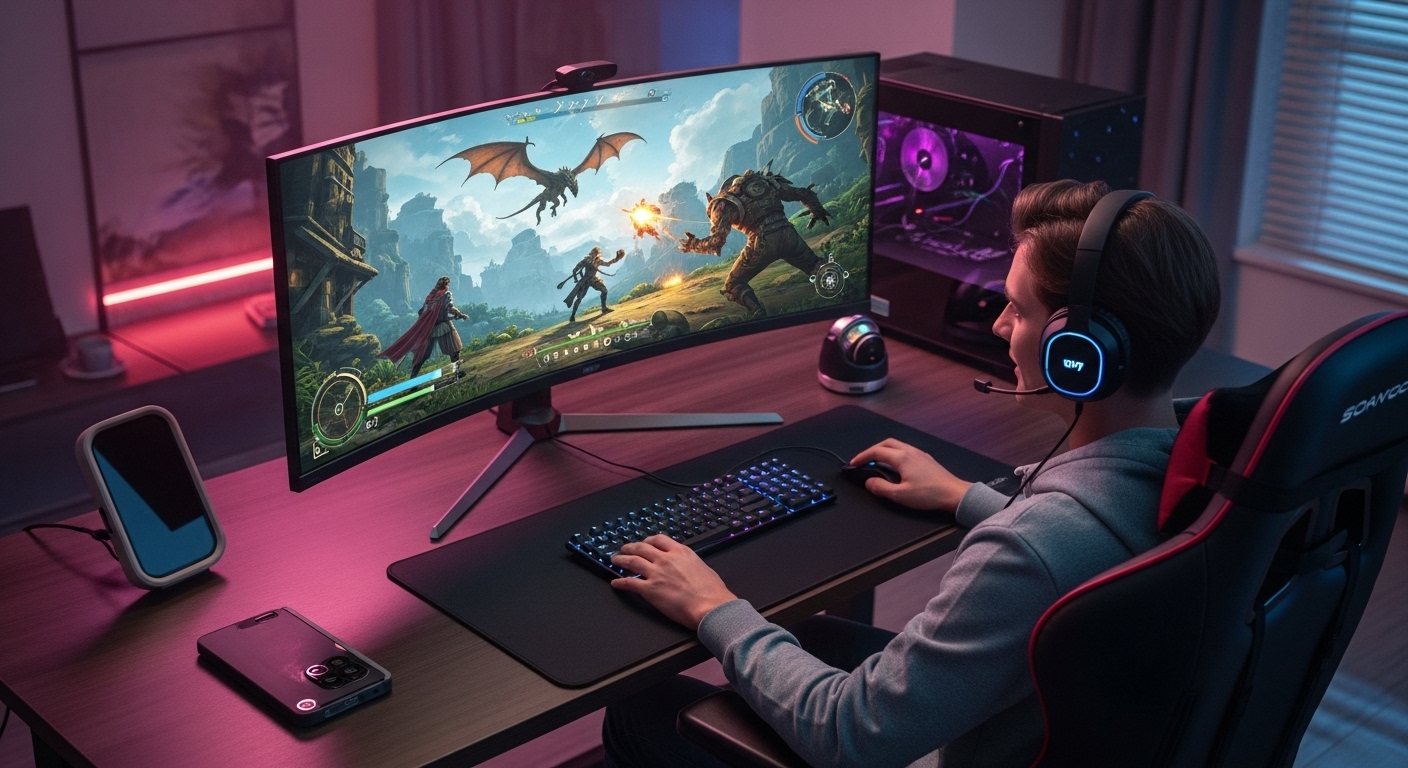
Gaming, in its various forms, has become one of the most influential aspects of modern culture. From the days of simple 8-bit graphics to today’s visually stunning, interactive worlds, the journey of video games has been nothing short of extraordinary. This blog will take a deep dive into the evolution of gaming, exploring how the industry has transformed, how technology has shaped the way we play, and how gaming has become a cultural phenomenon that connects people from all walks of life.
The Humble Beginnings of Video Games
In the late 1960s and early 1970s, the video game industry was nothing more than a mere experiment. The first commercially successful video game, Pong by Atari, was released in 1972. It featured simple gameplay—bouncing a dot (the ball) back and forth between two paddles. With its simplistic design and straightforward mechanics, Pong captivated a small audience in bars and arcades. It may seem rudimentary by today’s standards, but at the time, it was groundbreaking.
The 1970s and 1980s were the golden era of arcade gaming, with titles like Space Invaders (1978), Pac-Man (1980), and Donkey Kong (1981) taking the gaming world by storm. These games were straightforward and easy to pick up, making them accessible to people of all ages. Arcades became a cultural hub where people gathered to compete for high scores and socialize.
The Birth of Home Consoles
While arcades were the epicenter of gaming during the 70s and 80s, the real revolution came with the introduction of home consoles. In 1977, Atari launched the Atari 2600, one of the first consoles to bring video games into people’s homes. The concept of playing games in the comfort of one’s living room was revolutionary. The Atari 2600’s cartridge-based system allowed players to switch between games, a novelty at the time.
However, the true game-changer came in 1985 with the launch of the Nintendo Entertainment System (NES). The NES introduced a new standard for home gaming, with popular titles like Super Mario Bros., The Legend of Zelda, and Metroid creating franchises that are still popular today. The success of the NES not only solidified Nintendo’s place as a major player in the gaming industry but also ushered in an era where home gaming became a staple of daily life.
The Rise of 3D Graphics and CD-ROMs
As the 90s approached, technological advancements in gaming hardware began to accelerate. The shift from 2D to 3D graphics was one of the most significant milestones in the evolution of video games. The release of the Sony PlayStation in 1994 marked the beginning of the 3D era. Games like Gran Turismo, Final Fantasy VII, and Tekken showed the world that video games could be more than just fun pastimes—they could be intricate, cinematic experiences.
Alongside the evolution of graphics, CD-ROMs replaced cartridges as the medium for storing games. CD-ROMs provided much larger storage capacities, allowing developers to create more expansive games with better audio, full-motion video, and intricate storylines. This change also meant that games could be delivered to players with far more content, leading to the rise of expansive, open-world games like The Elder Scrolls III: Morrowind and Grand Theft Auto III.
The late 90s and early 2000s saw the launch of multiple consoles that would define the gaming landscape for years to come. The PlayStation 2 (2000), Xbox (2001), and GameCube (2001) competed for market dominance. Each of these consoles brought something unique to the table, whether it was the PlayStation 2’s vast library of games, the Xbox’s online capabilities with Xbox Live, or the GameCube’s innovative use of mini-discs.
Online Gaming and the Birth of Virtual Communities
As internet access became more widespread in the 2000s, online gaming exploded in popularity. Multiplayer games allowed players to connect with others around the world, transforming video games into a global social activity. Games like World of Warcraft, Counter-Strike, and Halo 2 were pioneers of this era, offering players the opportunity to compete, cooperate, and build relationships with people they would never meet in person.
The rise of online gaming also gave birth to virtual communities, with dedicated forums, fan websites, and platforms like Twitch (launched in 2011) allowing players to interact beyond the confines of the game itself. Social media and streaming platforms allowed gamers to share their experiences, tips, and gameplay, further cementing the idea that gaming wasn’t just about playing—it was about connecting.
In addition to online multiplayer games, the mid-2000s saw the introduction of downloadable content (DLC), allowing players to access new content for their favorite games without having to purchase a full sequel. This model proved to be highly successful, with many franchises—such as The Elder Scrolls V: Skyrim, Call of Duty, and The Sims—expanding their worlds through regular DLC releases.
The Transition to Modern Consoles and High-Definition Graphics
As technology continued to advance, gaming consoles became more powerful, and the gap between what was possible in gaming and reality started to shrink. The introduction of high-definition graphics in the mid-2000s, along with more powerful processing units, allowed for more detailed and lifelike game worlds. The Xbox 360 and PlayStation 3, both released in 2005, ushered in the HD era, and games like Gears of War, Uncharted: Drake’s Fortune, and The Last of Us showcased what next-gen graphics could achieve.
The move to HD gaming not only made games look better but also allowed for more immersive experiences. Open-world games like The Elder Scrolls V: Skyrim and Red Dead Redemption set new standards for world-building and narrative depth. Players could now interact with expansive environments in ways they had never done before. The high-definition visuals allowed developers to create more realistic characters, environments, and animations, bringing games closer to the feeling of living in another world.
The Rise of Mobile Gaming
As smartphones became more ubiquitous, mobile gaming quickly emerged as a dominant force in the industry. With millions of people carrying powerful gaming devices in their pockets, mobile games like Angry Birds, Candy Crush Saga, and Clash of Clans became household names. Mobile gaming democratized access to video games, allowing casual players to engage with games in short bursts during their commute or while waiting in line.
The rise of mobile gaming also created new opportunities for developers, who could now create games that didn’t require the heavy processing power of traditional consoles. Games like Pokémon GO blended the digital and physical worlds using augmented reality, while games like Fortnite introduced a new model of live service gaming with frequent updates, live events, and in-game purchases.
The Future of Gaming: Virtual Reality and Beyond
Looking ahead, it’s clear that gaming is continuing to evolve in exciting and unexpected ways. One of the most promising areas of development is virtual reality (VR). With the release of devices like the Oculus Rift and PlayStation VR, gamers can now step into fully immersive 3D worlds where they can look around, interact with the environment, and engage with other players in ways that were once the stuff of science fiction.
Virtual reality has the potential to redefine gaming, offering unparalleled immersion and the ability to experience games from a first-person perspective in a way that traditional screens can’t match. VR has applications beyond just gaming, including education, training, and virtual tourism, but the gaming industry is at the forefront of this technological innovation.
Beyond VR, technologies like augmented reality (AR), cloud gaming, and artificial intelligence (AI) are expected to play major roles in shaping the future of video games. AR could bring games into the real world in unprecedented ways, while cloud gaming could eliminate the need for expensive consoles by allowing players to stream games directly from powerful servers.
Gaming as a Cultural Phenomenon
While the technological advancements in gaming have been impressive, perhaps the most significant change is how gaming has become a cultural phenomenon. Video games are no longer just a hobby for a select group of people—they are now a mainstream form of entertainment enjoyed by millions worldwide.
Gaming has influenced music, film, and art, with video game soundtracks being performed in concert halls and video game stories being adapted into blockbuster films and television shows. Esports has emerged as a multi-billion-dollar industry, with professional gamers competing in tournaments that fill arenas and attract millions of viewers online. The gaming community is more diverse than ever before, with players from all walks of life coming together to share their love of gaming.
Conclusion: Gaming’s Unstoppable Growth
The gaming industry has come a long way from its humble beginnings. What started as a simple pastime for a few has now evolved into a global entertainment powerhouse. With each new technological breakthrough, gaming continues to push the boundaries of what is possible, offering players new worlds to explore, stories to experience, and people to connect with. As the industry continues to grow, it’s clear that the future of gaming is bright, and we are only just scratching the surface of what’s possible.
Whether you’re a lifelong gamer or someone who’s just beginning to explore the world of video games, one thing is certain: the evolution of gaming is an ongoing journey, and we’re all along for the ride.